Clock Tower
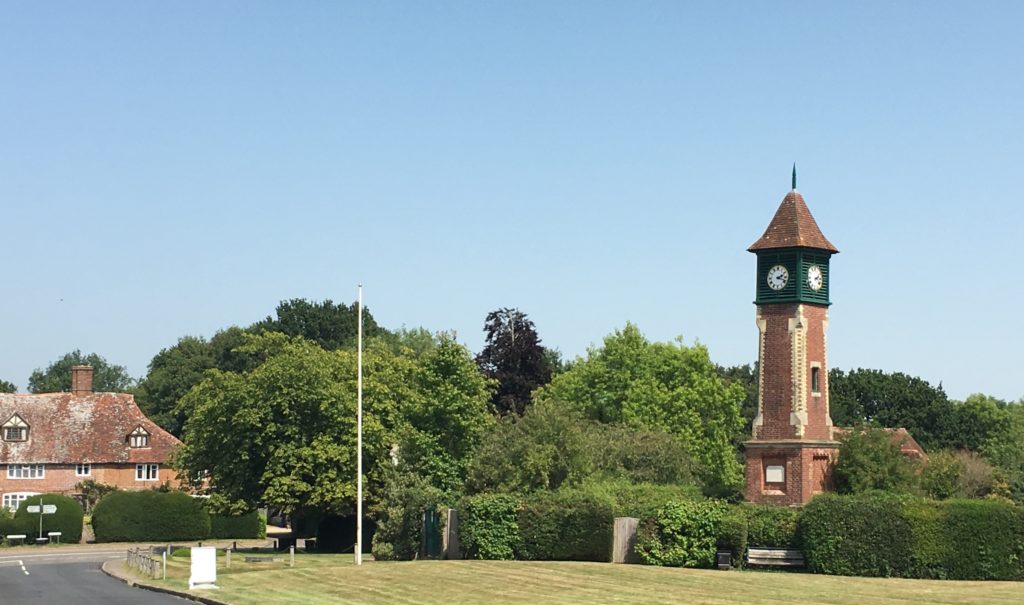
A significant landmark in the village is the clock tower, built in 1889 in memory of Arthur Oakes and is a grade II listed building.
The clock tower is located on the Upper Green.
THE SANDHURST CLOCK TOWER
The Sandhurst Clock Tower was erected in 1889 to honour Captain Arthur Oakes, a highly respected parishioner and Justice of the Peace who lived in the west of the village in the large house known as Downgate. The tower is positioned such that one clock dial directly faces the front door of Downgate and could, when the tower was built, be seen there almost a mile away. Unfortunately, trees now all but block the sight line to Downgate.
Arthur Oakes was born in 1822 in Hillingdon, Middlesex. He appears in Harts Army List 1840 in the 13th Regiment of Foot with the rank of Ensign (this rank became Second Lieutenant in 1848). While still in the army, he married Sarah Caroline Bushnell of Beenham in Berkshire on 5th November 1849 in the Church of the Holy Trinity, Ryde, on the Isle of Wight. His father is given as Major Laurence Oakes and Sarah’s as John Bushnell, Clerk (i.e. clergyman).
By 1851 Arthur Oakes had left the army and he and Sarah were living in Biting House, Godmersham (now a listed building) on the road between Ashford and Canterbury. At this time, he was a ‘Fund and Landowner’. Living with them at Godmersham was Sarah's sister, Hannah Maria Bushnell (1821-1886). She is described in the 1851 Census as a ‘Fund Holder’. She married Thomas Lawrence Aston in Sandhurst in 1862, the service being conducted by the Rev Thomas Hext Bushnell MA, vicar of Beenham, assisted by Rev R Stafford Bushnell MA.
By the time of the 1861 census Arthur and Sarah Oakes had moved to Downgate in Sandhurst (Hannah was no longer living with them) and Arthur is listed for the first time in the census records as a Justice of the Peace for Kent.
Arthur Oakes died on 8th February 1889 of an angina attack in the stable yard at Downgate. Sarah continued to live at Downgate for a few years. By the time of the 1891 census she had her nephew, Gilbert DS Bushnell from Gonville, Jersey, staying with her. He was a 21-year-old student at Oxford a t the time. At some time after this she moved to the Isle of Wight where she died of cancer on 10th November 1900 at the Marine Hotel, Ventnor, Isle of Wight aged 79. As well as being described as the widow of Arthur Oakes she was also described as a ‘landed proprietor’. It is not believed that Arthur and Sarah had any children.
The people of the village of Sandhurst were keen to keen to commemorate the life of Arthur Oakes. In 1889 a plot of land measuring ‘two perches more or less’ was sold by Thomas Slaughter and his wife Mary for the sum of two pounds to the village of Sandhurst for the purpose of erecting a Memorial to Arthur Oakes Esq JP
The Memorial, in the shape of a Clock Tower, was built by David Winser, the grandfather of Tom Small who lived at Bell Farm (opposite the Old Post Office). The Tower was built so that the West Face is in a direct line with the front door of Downgate. (These facts have been taken from the original deeds). On completion of the structure, a frightened Mabel, (the mother of Tom Small) was hoisted in a bucket to the top of the tower to put into place the final brick.
In the Guildhall Library in London there are ‘Daybooks' recording daily transactions by Thwaites and Reed (Clockmakers). The entry for the Sandhurst clock movement is as follows:
The Movement, two dials and bell cost £64.0s.0d, two extra dials cost £10.10s.0d. All were delivered and fitted on the 10th October 1889. The entry also states that the dials are 3 feet in diameter, the movement is dead beat with rod and pendulum and that the Bell weighs 2 cwt (just over 100Kg).
In more technical detail, the clock movement is a two-train cast iron flatbed with a recoil anchor escapement. This drives the four dials through a vertical shaft which drives bevel gears and counterpoised motion work. The dials are 36 inches in diameter and are opal skeletons. The hands are made of ribbed copper. The striking train operates a single hammer striking a 23 inch diameter bell. The dials are now each backlit with three LED lamps placed internally around the dials. The lamps have a low colour temperature of around 2,000Kº which is quite an orange light. This is to replicate the oil lamps which would have been used when the clock was first installed.
The movement, which requires winding once a week. Over time many people must have had the responsibility for clock winding. In recent times Ron Matthews and John Gillingham have undertaken this role. Terry Hannocks is the current winder and has been doing the job since 2012. The chimes require to be wound 54 turns and the clock 42.
In 1989, to commemorate the centenary of the Clock Tower, a special collection of commemorative chinaware was produced, with several pieces distributed internationally to destinations such as the USA, South Africa, Australia, and Europe. During that year, Ron Matthews, then Chairman of the Parish Council, presented a set of this chinaware to the Mayor of Paris, Jacques Chirac, in conjunction with the Eiffel Tower’s own centennial celebrations.
By 2012, the clock required significant repairs, with the previous maintenance having occurred in 2004. During 2012-14, the Parish Council restored the clock and tower under guidance from the Tunbridge Wells Conservation Officer. The clock mechanism, structure and clock dials were all very carefully restored under the guidance of the Tunbridge Wells Conservation Officer. To mark the completion of the works and the clock’s 125th birthday, a fete was held on the Upper Green.
Terry Hannocks
16th October 2025