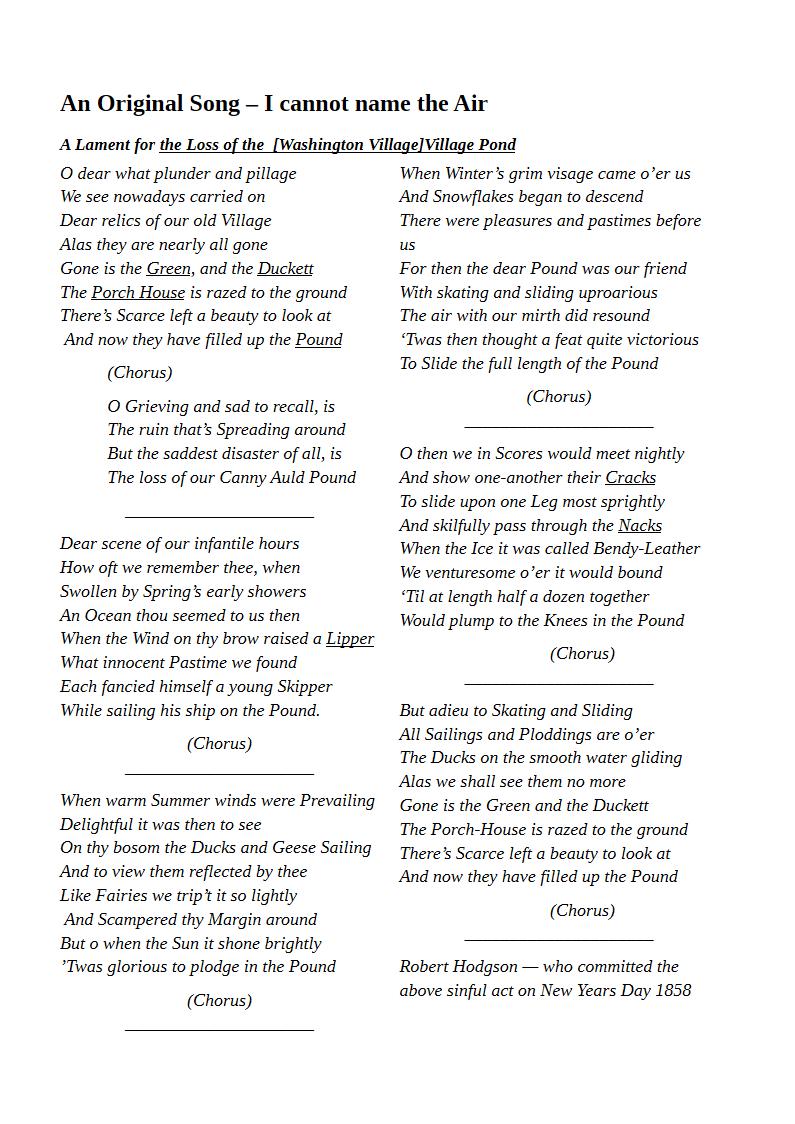
'The Auld Village Pound'
Like most rural villages Washington had a pond at it centre. The 1857 Ordnance Survey map shows it was lozenge-shaped and quite large- about 120 feet by 60 feet. Today it is the site of the War Memorial erected in 1920, and where President Jimmy Carter and Prime Minister Jim Callaghan planted trees in 1977.
The pond was fed by streams from the higher ground to the west from the Mount, near Springwell, into the Washington Colliery pit pond, diagonally to Spout Lane (hence its name) and down into the village. It drained to the southern boundary of The Old Hall, where it turned east, serving a mills in the grounds of Old Hall and adjoining farms, continuing down to a reservoir this side of the Pontop to South Shields railway, across from the Washington Chemical Works, before draining into the River Wear at Washington Staithes.
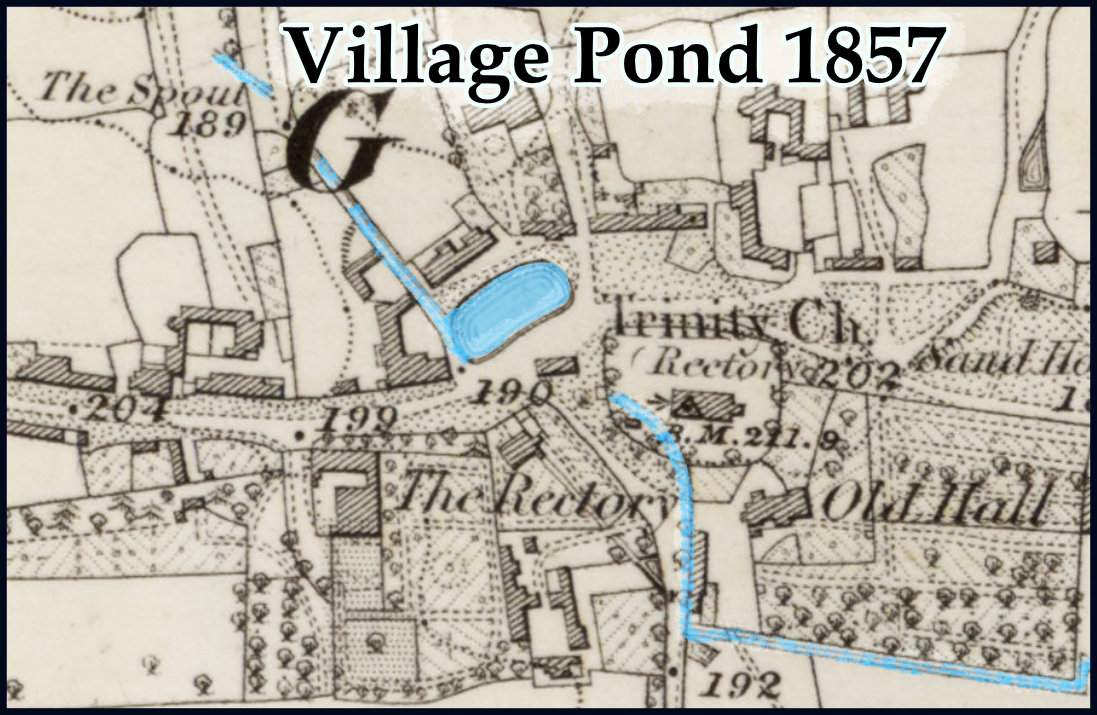
Ponds had been a common resource for agricultural and recreation purposes, but industry owners were diverting waterway courses and discharging into streams, which inevitably polluted them. It was also increasingly recognised that ponds were the source of many deadly diseases. The Public Health Act of 1848 placed a duty on local authorities to provide clean water for human consumption, and to control sewerage. In Washington this became the responsibility of the Chester Le Street Poor Law Union (PLU).
Municipalities started to regulate and fill in polluted ponds. This could have been the reason the Washington Village Pond was filled in on New Years Day 1858.
This date was discovered by local resident, Dougie Bottoms, when he came across a handwritten poem lamenting its loss. Unfortunately we do not know who wrote it, or the tune it was set to.
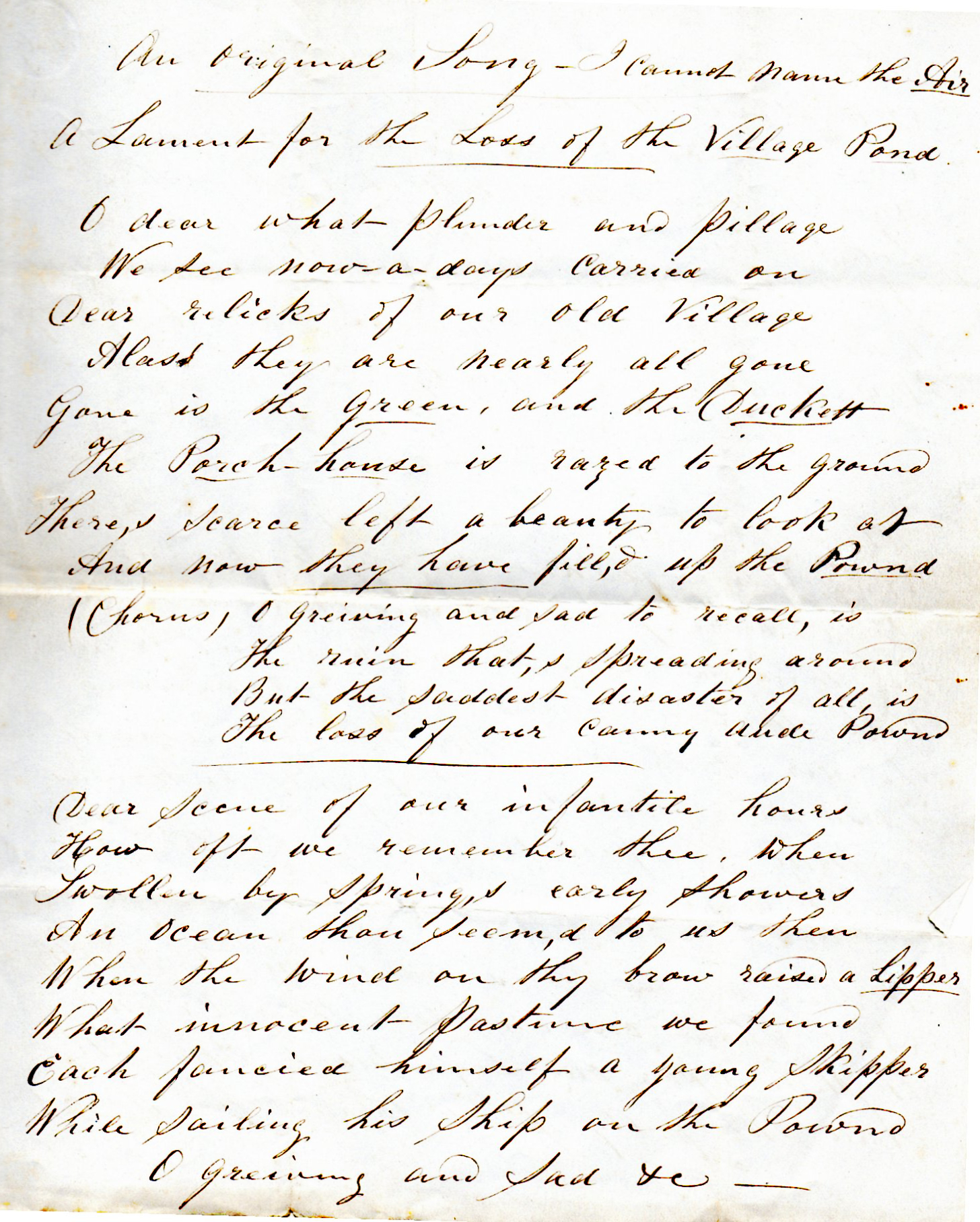
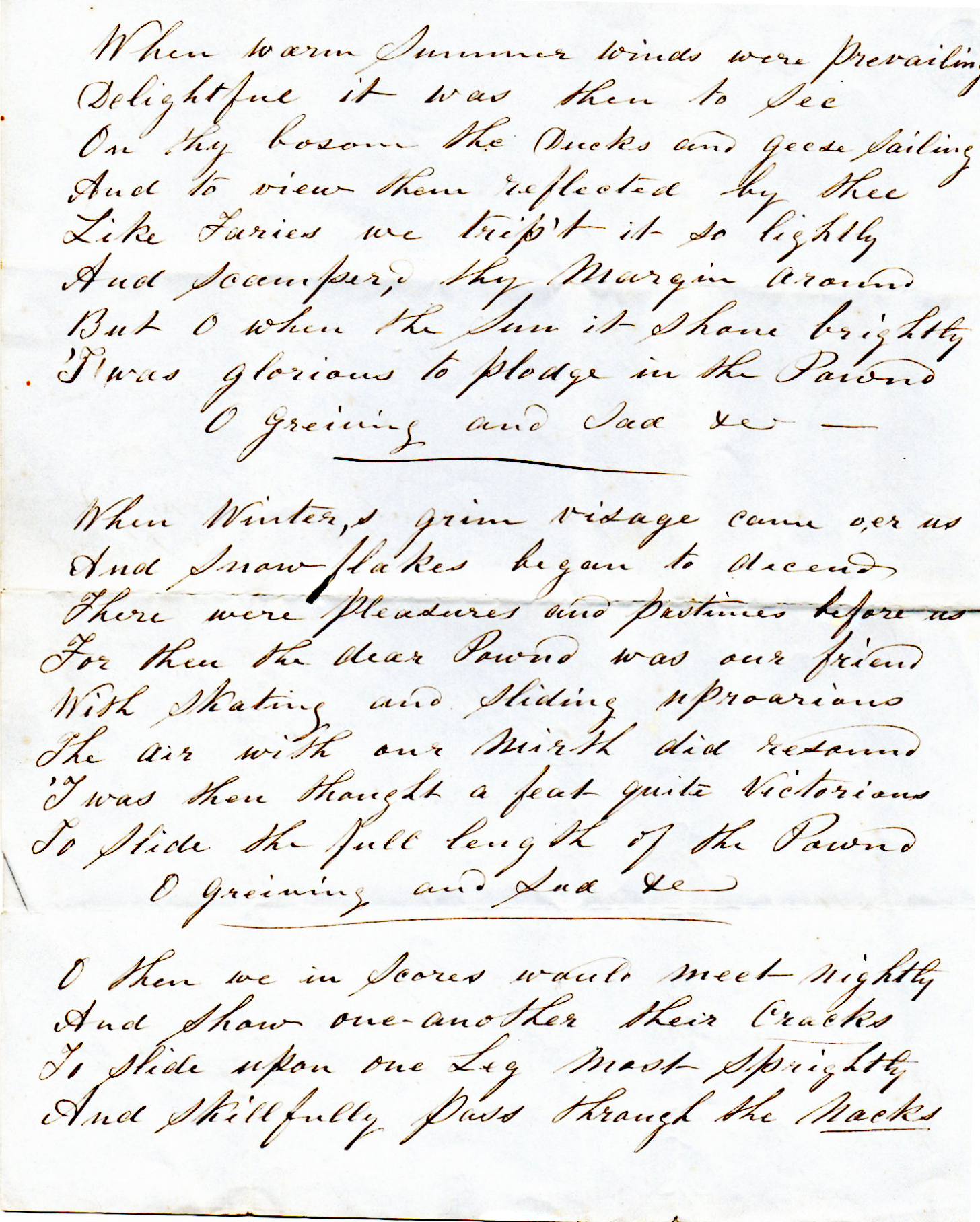
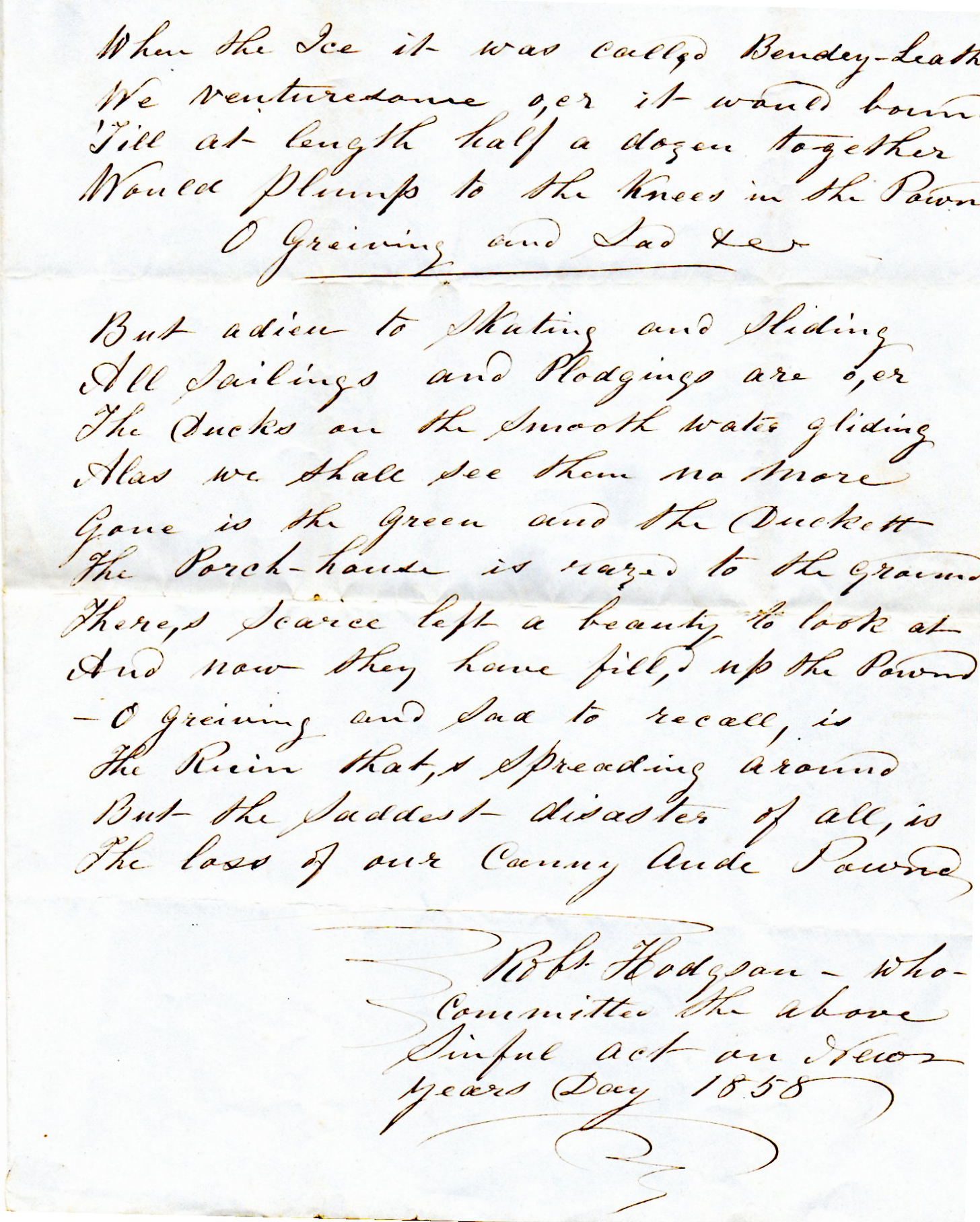
It has six verses and a chorus describing the yearly cycle of the life of the pond. It mourns the loss of other features of the village; The Green, the Duckett (dovecote), and the Porch. This was known as The Lords' Porch, attached the south side of the old Holy Trinity Church demolished in 1832, 20 feet long and 15 feet broad, the burial place of the old Lords of the Manor.
It has old terms for rhyming purposes; Lipper (gentle waves on water), plodging (wading) and Cracks, Nacks and Bendy-Leather (descriptions of ice). And the author phonetically wrote it as 'The Canny Auld Pound’.
It is signed off with a condemnation of Robert Hodgson for committing ‘this sinful act’. I’ve not been able to identify a local man called Robert Hodgson; maybe he was a PLU Commissioner who ordered the works, or the contractor who completed them?
We don’t know the origins of the poem, but it could be the writer was a child in the 1830s, and writing the lament 30 years later. However it does gives us a fascinating insight into the not always welcomed changes as Washington grew, not unlike its later transition to a New Town a century later!